
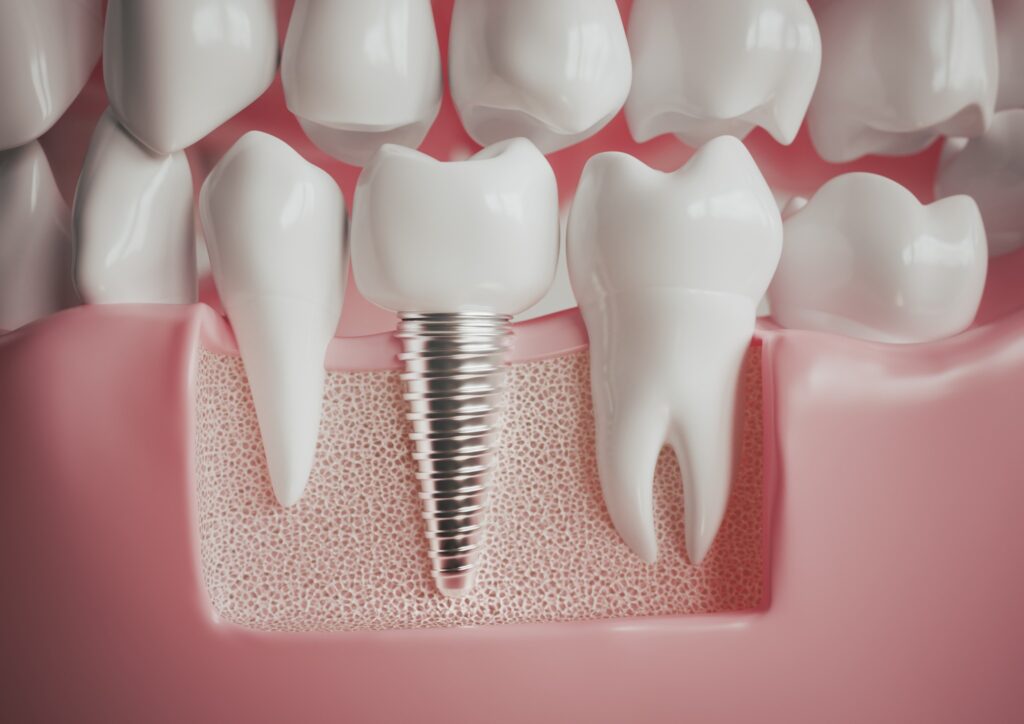
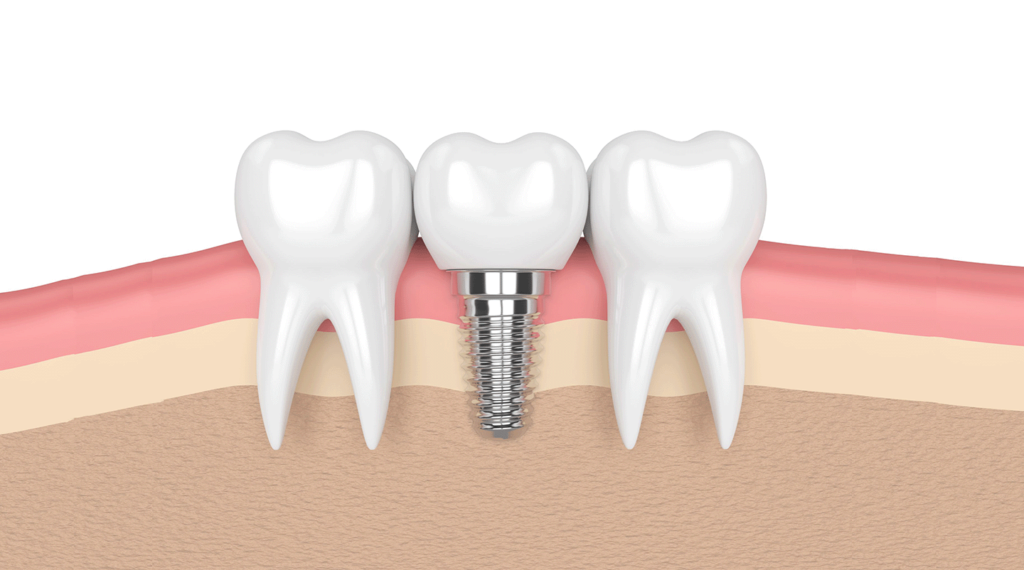
Dental implantation is a surgical procedure in dentistry aimed at restoring lost dental units by embedding an artificial titanium root (implant) into the jaw and subsequently loading it with a crown made of the appropriate material via an abutment.
The absence of teeth not only causes aesthetic problems, especially if the defect occurs in the smile zone. Most often, the loss of dental units leads to internal discomfort and embarrassment when communicating with others, affects speech clarity and the normal process of chewing food, leads to a decrease in bone tissue and changes in facial contour. Over time, a person tends to smile less, withdraws socially, and may experience certain psychological disorders.
Thus, dental implantation serves to restore the natural appearance and functionality of dental arches, returning the patient to their usual way of life. Artificial teeth cannot be distinguished from healthy ones and practically serve for a lifetime, effectively performing their functions.
Contraindications for dental implantation include numerous factors, which can be divided into absolute and relative ones.
Absolute contraindications are circumstances that categorically prohibit the implantation procedure into the jawbone:
Relative contraindications are circumstances under which implantation is possible after their elimination:
The doctor collects medical history, conducts an examination of the patient's oral cavity, assesses the condition of soft and hard tissues, analyzes data from additional examinations, consults with related specialists. Develops an optimal treatment plan and presents it to the patient, determining the type of implant and abutment, as well as the shape and color of the artificial crown.
The surgery begins with local anesthesia. Then, to gain access to the jawbone, the surgeon makes an incision in the gums and carefully screws the implant into the bone, achieving its primary stabilization until the moment of final integration (osseointegration), places the gingival former, and sutures the wound. In some cases, immediate loading of the implant with an artificial crown is possible. The next step involves taking impressions from the upper and lower jaws and sending the obtained data and materials to the dental laboratory for crown fabrication. Subsequently, the doctor and the patient wait for the implant to fully integrate into the bone (on average, this period takes from 3 to 6 months).
After the implant has fully integrated into the bone and the finished crown is received from the laboratory, the doctor removes the gingival former and fits the orthopedic structure. If defects are found in the product at this stage, it is sent back to the laboratory for refinement. In a positive scenario, the crown is installed cemented or screwed onto the implant, the occlusion of tissues and jaw closure are checked. Several weeks later, the patient's well-being, the condition of the crown, and the adaptation of the gums are monitored.
The cost of dental implantation at our clinic consists of many factors. The type of implant selected, whether budgetary or premium, plays an important role. This determines how long the implant will last, the risk of possible rejection, and much more.
The material used to make the crown and the type of abutment also affect the cost. Metal-ceramic products are considered the cheapest, while zirconium is the most expensive.
It’s important to consider the number of teeth being restored, as this proportionally increases the cost of treatment. The more teeth are damaged, the more advanced the disease, the more time and financial investment are required to address the pathology.
Additionally, accompanying medical procedures must be taken into account. For example, if there is insufficient bone tissue, additional surgery for its augmentation is necessary.
All these factors determine the final cost of implantation. In our clinic, dental surgeons provide the cost of treatment during a free consultation so that each patient can assess their financial capabilities based on individual preferences. It’s worth noting that we offer competitive prices for this service with fully transparent pricing and no hidden fees, including turnkey solutions.
Dental implantation is essentially an invasive treatment method. Therefore, after the operation, it is necessary to follow some simple recommendations:
You can find out the price of dental implantation at ORTHO Clinic by following the link or during a free consultation with our specialists.
© ORTHO dental clinic2026
Leave your contact details and we will help you choose a specialist and make an appointment at a convenient time.
Залиште свої контактні дані, і ми допоможемо вам обрати спеціаліста та записатися на зручний час.
Ми зв’яжемось з вами найближчим часом